
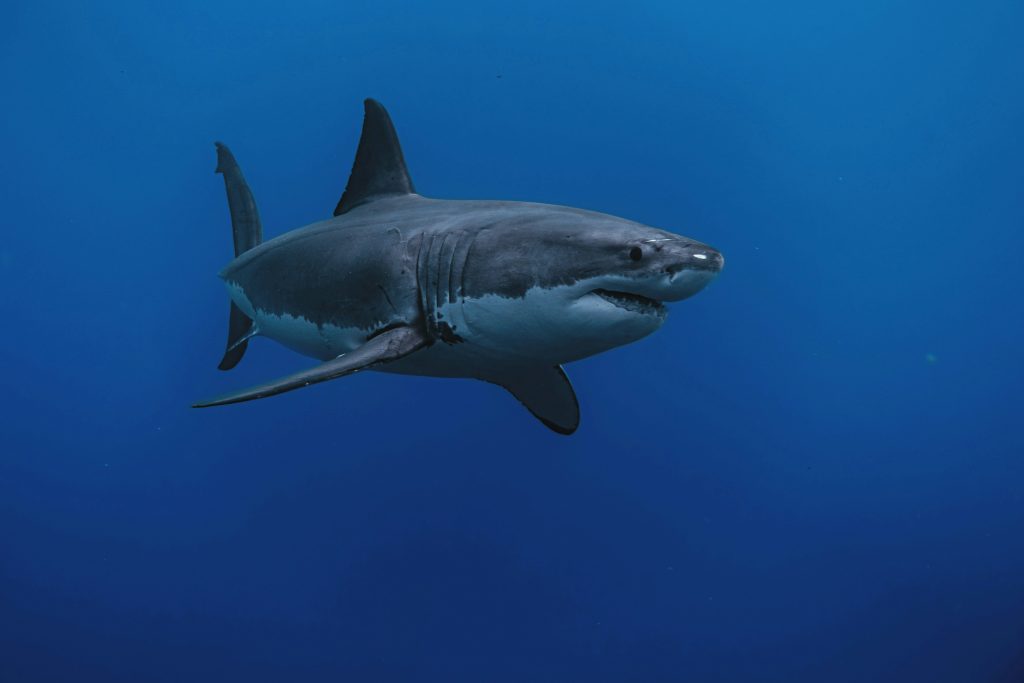
Shocking facts about sharks reveal just how extraordinary these ancient predators really are. Sharks have inhabited Earth’s oceans for more than 400 million years, surviving dramatic changes in climate, sea levels and marine ecosystems.
Long before humans walked the planet, long before dinosaurs dominated the Earth and even before forests became widespread on land, ancient shark relatives were already swimming through prehistoric oceans.
Yet sharks have developed an unfortunate reputation.
Movies such as Jaws have encouraged people to imagine sharks as mindless killing machines constantly searching for humans. The reality is considerably more fascinating. Most sharks do not consider humans their natural prey, and their behaviour is far more complex than popular culture suggests.
From their remarkable ability to detect electricity to their constantly replacing teeth, sharks possess some of the most unusual adaptations in the animal kingdom.
These shocking facts about sharks show why these animals deserve to be understood rather than simply feared.
In this article, we explore 15 fascinating facts about sharks, including their ancient evolutionary history, extraordinary senses, unusual reproductive strategies, incredible physical adaptations and important role in marine ecosystems.
1. Sharks Are Older Than Dinosaurs and Ancient Enough to Pre-Date Trees
One of the most astonishing shocking facts about sharks is their incredible age.
Shark-like animals existed more than 400 million years ago. This places their evolutionary history far before the appearance of the first dinosaurs, which emerged roughly 230 million years ago.
Humans are extremely recent in comparison.
Our species has existed for only a tiny fraction of Earth’s history, while shark lineages have had hundreds of millions of years to adapt to changing oceans.
Fossilised shark teeth and scales provide some of the strongest evidence of their ancient history. Because sharks have skeletons made primarily from cartilage, complete fossilised skeletons are much rarer than their teeth.
Over geological time, shark species have appeared, evolved and disappeared. So it would be inaccurate to say that modern sharks are exactly the same animals that existed hundreds of millions of years ago.
Instead, their basic evolutionary body plan has proved remarkably successful.
Shark ancestors survived several major extinction events and continued evolving as marine environments changed around them.
This is one reason these ancient predators are so scientifically important.
They provide researchers with an opportunity to study how successful body designs can persist and diversify over immense periods of evolutionary time.
When people hear shocking facts about sharks, their age is often one of the first facts that changes how they think about these animals.
2. Sharks Don’t Have a Traditional Bony Skeleton
Another of the strangest facts about sharks is that their skeletons are made primarily from cartilage rather than ordinary bone.
Cartilage is the flexible connective tissue found in parts of the human body, including the nose, ears and joints.
In sharks, however, cartilage forms the framework of almost the entire body.
This gives sharks a comparatively lightweight and flexible skeleton, helping them move efficiently through water.
Their bodies are also streamlined for marine life. Their fins provide stability and steering, while their powerful tails generate thrust.
Sharks also have another important adaptation: their enormous livers.
A shark’s liver can contain large amounts of oil, including a compound called squalene. These oils contribute to buoyancy and help compensate for the absence of the gas-filled swim bladder found in many bony fish.
This does not mean sharks simply float effortlessly.
They still need to control their position in the water through swimming, fin movements and body posture.
The combination of cartilage, specialised muscles, fins and a large oily liver creates an extremely effective marine body plan.
This is one of the shocking facts about sharks that demonstrates how differently their bodies evolved compared with those of humans and other land animals.
3. Sharks Can Replace Thousands of Teeth Throughout Their Lives
If there is one feature people immediately associate with sharks, it is their teeth.
But one of the most interesting shocking facts about sharks is not simply that they have sharp teeth. It is that many sharks can continuously replace them.
Humans generally receive two sets of teeth during their lives.
Sharks operate differently.
Many species have several rows of teeth, including replacement teeth developing behind the functional front row. When an active tooth becomes damaged or falls out, another tooth can move forward.
This creates something resembling a biological conveyor belt.
Depending on the species, an individual shark can go through thousands of teeth during its lifetime, and some estimates suggest that certain sharks may produce tens of thousands.
The shape of the teeth also tells scientists about a shark’s diet.
Great white sharks have broad, triangular and serrated teeth suited to cutting through flesh.
Other sharks have narrower teeth designed for gripping fish, while species that consume hard-shelled prey may have teeth adapted for crushing.
Shark teeth are also incredibly useful to palaeontologists.
Because teeth are made from much harder material than cartilage, they fossilise relatively well. This is why ancient shark teeth are commonly found in rocks dating back millions of years.
In fact, fossilised teeth provide some of the most important evidence about sharks that lived long before modern species appeared.
4. The Whale Shark Is Bigger Than a School Bus
The whale shark is the largest living shark species and the largest known fish in the world.
Large whale sharks can reach approximately 12 metres or more in length.
That means an enormous whale shark can be longer than a typical school bus.
Yet its enormous size hides another one of the most shocking facts about sharks.
The whale shark is generally a gentle filter feeder rather than an active predator of large animals.
It feeds primarily on plankton, tiny organisms and small fish.
Instead of chasing large prey, it takes enormous amounts of water into its mouth and filters food particles from the water as it passes through specialised structures associated with its gills.
This makes the whale shark an excellent example of how evolution can produce dramatically different lifestyles within the same group of animals.
A great white shark and a whale shark may both be sharks, but their feeding strategies are completely different.
Whale sharks also have distinctive patterns of spots and stripes across their bodies.
Researchers can use these patterns to identify individual animals, allowing scientists to monitor movements and populations.
Despite their enormous size, whale sharks are generally considered harmless to humans.
They are therefore a perfect reminder that size and danger are not necessarily connected.
5. The Smallest Sharks Can Fit in Your Hand
At the opposite end of the size spectrum is the dwarf lantern shark.
This tiny deep-water species is among the smallest known sharks and can reach only around 20 centimetres in length.
That is small enough to fit comfortably in many people’s hands.
But its tiny body contains an extraordinary adaptation.
The dwarf lantern shark can produce light through specialised organs called photophores.
This ability is known as bioluminescence.
Bioluminescence is particularly useful in the deep ocean, where sunlight becomes extremely weak or disappears entirely.
One possible function is counterillumination.
A predator looking upward may see a faintly illuminated underside rather than a dark silhouette against the light filtering down from above.
The light may also have roles in communication or attracting prey.
This is among the most unusual shocking facts about sharks because many people do not realise that some sharks are capable of producing their own light.
When we imagine sharks, we generally picture large animals near the ocean surface.
But shark species occupy an enormous variety of environments, including the deep sea.
The dwarf lantern shark demonstrates just how diverse shark evolution has become.
6. Sharks Have a Sixth Sense That Detects Electricity
Perhaps one of the most incredible shocking facts about sharks is that they can detect electricity.
All living animals produce tiny electrical signals as their muscles and nervous systems function.
Humans cannot consciously detect these signals.
Sharks can.
Specialised sensory organs called the Ampullae of Lorenzini allow sharks to detect extremely weak electrical fields in the water.
These organs appear as small pores around the shark’s head and connect to sensory structures underneath the skin.
Electroreception can be especially useful when a shark is hunting prey that is difficult to see.
Imagine a fish hiding beneath sand.
The shark may not have a clear visual signal, but the fish’s muscles and nervous system continue producing tiny electrical signals.
At close range, the shark can potentially detect them.
Hammerhead sharks are particularly interesting because their broad, flattened heads spread sensory organs across a large area.
This may allow them to scan more of the seafloor while searching for prey.
Electroreception is therefore one of the clearest examples of how sharks possess sensory capabilities that humans simply do not have.
7. Some Baby Sharks Eat Their Siblings Before Birth
This is undoubtedly one of the most shocking facts about sharks.
In certain shark species, developing embryos can compete with one another inside the mother’s reproductive tract.
The sand tiger shark is particularly famous for this behaviour.
Sand tiger shark embryos can engage in intrauterine cannibalism, meaning that larger embryos consume smaller developing siblings before birth.
A female may initially produce several embryos, but only a small number survive until birth.
The strongest embryos can consume smaller competitors, leaving fewer but larger pups.
From a human perspective, this behaviour sounds horrifying.
From an evolutionary perspective, however, it can provide an advantage.
The pups that survive are larger and more developed when they enter the ocean, potentially improving their chances of survival.
Importantly, this behaviour does not occur in all sharks.
Shark reproduction is incredibly diverse, and intrauterine cannibalism represents one specialised strategy found in particular species.
It is nevertheless one of the most memorable shocking shark facts because it demonstrates just how different animal reproductive strategies can be from our own.
8. Sharks Have Several Different Reproductive Strategies
Another fascinating fact about sharks is that they do not all reproduce in the same way.
Depending on the species, sharks can lay eggs, give birth to live young or use reproductive strategies in which eggs develop and hatch inside the mother before the pups are born.
Some sharks lay tough protective egg cases.
These structures are sometimes popularly called “mermaid’s purses.”
The developing embryo remains protected inside the case until it is sufficiently developed to hatch.
Other species give birth to relatively well-developed young.
Some sharks also have surprisingly long gestation periods.
This reproductive diversity is one reason scientists find shark biology so interesting.
The different strategies reflect the environments in which different species live.
A species living in a relatively stable habitat may have evolved a different reproductive strategy from one whose offspring must immediately survive in a dangerous open-ocean environment.
Sharks also tend to produce fewer offspring than many highly reproductive fish species.
That has important conservation consequences.
If a shark population loses large numbers of adults, it can take a long time for the population to recover.
Understanding these reproductive differences is therefore essential when scientists develop conservation strategies.
9. Sharks Don’t Roar or Scream Like They Do in Movies
If you have watched a shark movie, you may remember the dramatic sound effects that accompany a shark approaching its victim.
Real sharks do not produce those terrifying movie sounds.
Sharks do not have vocal cords like humans and many terrestrial mammals.
The famous underwater roars, screams and dramatic sounds associated with shark attacks are primarily products of film and television sound design.
Sharks can certainly interact with their environment and produce physical sounds through movement, but they are not communicating through dramatic vocalisations like fictional movie monsters.
This is one of the shocking facts about sharks that highlights the difference between popular culture and biology.
Hollywood has played a major role in shaping public attitudes toward sharks.
The image of a shark deliberately hunting humans has become deeply embedded in popular culture.
But real shark behaviour is considerably more complicated.
Sharks investigate their surroundings, hunt natural prey, respond to environmental cues and sometimes bite humans.
That does not mean humans are their preferred food.
10. The Shortfin Mako Is One of the Fastest Sharks
The shortfin mako is widely regarded as one of the fastest sharks in the ocean.
Frequently cited estimates suggest that it can reach speeds of around 45–50 mph (72–80 km/h) under exceptional conditions.
Exact top speeds are difficult to measure in wild sharks, so these numbers should be treated as estimates rather than precise speedometer readings.
The mako’s body is built for speed.
Its streamlined shape reduces resistance, while its powerful tail provides propulsion.
It also has specialised physiological adaptations that help it maintain relatively warm muscles compared with the surrounding water.
This allows the shark to remain an exceptionally effective high-speed predator.
The mako hunts fast-moving prey including tuna and other fish.
Its speed is another reminder that there is no single “standard shark.”
A whale shark is built for filter feeding.
A dwarf lantern shark is adapted to deep, dark environments.
A mako is built for speed and pursuit.
These differences are among the most fascinating facts about sharks because they reveal how dramatically evolution can modify the same basic body plan.
11. Some Sharks Can Survive Long Periods Without Food
Food availability in the ocean is not always predictable.
Predators can sometimes go extended periods without finding sufficient prey.
Some shark species are capable of surviving surprisingly long periods without eating.
Several biological adaptations contribute to this ability.
Their large livers can store substantial energy reserves, while their metabolism allows them to conserve energy under certain conditions.
However, this fact is often exaggerated online.
It would be incorrect to claim that every shark can survive for years without food.
The ability to withstand fasting varies between species and depends on factors such as body size, age, water temperature, health and stored energy.
Some sharks have been observed or reported to survive for months without feeding under particular circumstances.
This ability becomes particularly useful in environments where food availability changes seasonally.
Rather than treating sharks as animals that can simply live indefinitely without food, it is more accurate to say that some species have evolved impressive adaptations for dealing with periods of scarcity.
12. Shark Attacks on Humans Are Extremely Rare
Perhaps the most important of all these shocking facts about sharks is that attacks on humans are extremely uncommon.
Shark attacks do happen.
Some can cause serious injury, and a small number are fatal.
But millions of people enter the ocean every year, while only a tiny proportion encounter sharks in a way that results in an attack.
Most shark species do not regularly prey on humans.
There are several possible explanations for shark bites involving people.
In some circumstances, a shark may investigate an unfamiliar object with its mouth.
In other situations, a person may be mistaken for natural prey, particularly when visibility is poor.
Some encounters may also occur because humans and sharks are occupying the same environment while pursuing different activities.
A shark bite can be extremely dangerous because sharks are powerful wild animals.
But the idea that sharks spend their lives looking for humans to eat is simply not supported by the evidence.
Understanding this distinction is important.
Fear of sharks is understandable, but fear should not replace accurate information.
The ocean is a wild environment, and sensible precautions are always appropriate. At the same time, sharks should not be portrayed as monsters.
13. Many Shark Species Are Threatened With Extinction
Perhaps the most concerning of these shocking facts about sharks is that many species face serious conservation challenges.
The greatest threat to sharks is generally not shark attacks on humans.
It is human activity.
Overfishing, bycatch, habitat degradation and other environmental pressures have affected shark populations around the world.
Some sharks are deliberately targeted for their meat, fins and other products.
Others are accidentally caught while fishing operations target different species.
Sharks can be particularly vulnerable because many species grow slowly, mature relatively late and produce comparatively few young.
This means populations may recover slowly after major losses.
The ecological importance of sharks also makes their conservation significant.
As predators, sharks influence the behaviour and abundance of other animals within marine ecosystems.
Removing large numbers of predators can therefore change relationships throughout a food web.
Not every shark species faces exactly the same level of risk.
Some populations are relatively stable, while others are under severe pressure.
The important lesson is that conservation strategies need to consider the biology of individual species rather than treating all sharks as one uniform group.
14. Some Sharks Can Open Their Jaws Extremely Wide
A shark’s jaw is another extraordinary piece of evolutionary engineering.
Unlike the rigid jaw structure found in humans, many sharks have jaws that can move in ways that allow them to extend forward during feeding.
This helps them capture and grip prey effectively.
Large predatory sharks demonstrate this ability particularly dramatically.
Great white sharks, for example, can open their jaws extremely wide when attacking prey.
Their triangular, serrated teeth work together with powerful jaw muscles to cut through flesh.
But different sharks use their mouths in completely different ways.
Nurse sharks can generate powerful suction while feeding near the seafloor.
Whale sharks use their enormous mouths as part of a specialised filter-feeding system.
This means that even among sharks, “having a big mouth” does not necessarily mean having the same feeding behaviour.
The structure of the jaws, teeth and feeding system has evolved differently depending on what each species eats.
These are some of the shocking facts about sharks that show why it is misleading to think of every shark as simply a smaller or larger version of the great white.
15. Shark Skin Feels Like Sandpaper for a Reason
Run your hand along shark skin from the head toward the tail and it can feel relatively smooth.
Move in the opposite direction and it can feel surprisingly rough.
This is because shark skin is covered with microscopic structures called dermal denticles.
The name comes from their tooth-like structure.
Dermal denticles provide protection and influence the way water flows around the shark’s body.
Their backward-pointing arrangement helps create a streamlined surface.
Instead of allowing water to move randomly across the body, the denticles influence the boundary layer of water flowing along the shark.
This can reduce turbulence and contribute to efficient swimming.
The principle has inspired research into biomimicry, where engineers study natural structures and use their underlying principles to develop human technologies.
Shark-inspired surfaces have been investigated for applications involving fluid flow and drag reduction.
So shark skin is not simply rough armour.
It is a highly specialised biological surface that has evolved to protect the shark while also helping it move efficiently through water.
This is another example of why shocking facts about sharks can reveal fascinating connections between biology and technology.
Why These Shocking Facts About Sharks Matter
These shocking facts about sharks reveal a very different picture from the one created by Hollywood.
Sharks are not simply giant predators with rows of terrifying teeth.
They are highly specialised animals shaped by more than 400 million years of evolution.
Their bodies contain extraordinary adaptations, including cartilage skeletons, continuously replacing teeth, electroreception, specialised sensory systems, powerful swimming muscles, unusual reproductive strategies and streamlined skin.
Some sharks are enormous.
Others are tiny.
Some hunt at high speed.
Others filter microscopic organisms from seawater.
Some live near coastlines, while others inhabit the deep ocean.
Some species can even produce their own light.
The diversity found within the shark family is one of the greatest reasons these animals deserve scientific attention.
At the same time, learning about sharks can help replace unnecessary fear with understanding.
That does not mean sharks should be treated as harmless.
They are wild predators, and people should always respect marine wildlife and follow local safety guidance.
But understanding the real behaviour of sharks helps put the risk into perspective.
The ocean is an enormous ecosystem containing countless species, and sharks occupy important positions within many marine food webs.
Their disappearance can therefore affect other organisms and ecological relationships.
This makes shark conservation about much more than protecting an iconic animal.
It is also about protecting the health and balance of marine ecosystems.
Beyond Sharks: Exploring Our Relationship With the Ocean
The story of sharks is ultimately part of a much larger story about our relationship with the ocean.
Understanding shocking facts about sharks helps us appreciate the complexity of marine ecosystems, but there’s another side to this relationship worth experiencing firsthand — how people are increasingly stepping into the water themselves, not just reading about what lives beneath it.
Across Kerala, and right here on the Kovalam coast, the ocean is becoming more than a place to admire from the shore. Scuba diving, snorkelling, and a range of watersports are opening up a whole new way to connect with marine life and the underwater world.
If these shocking facts about sharks have sparked your curiosity about what else the ocean has to offer, the best next step isn’t another article — it’s getting in the water.
Ready to see it for yourself?
Head to Bond Safari Kovalam and dive into the underwater world in person. Whether you’re scuba diving among reef life, snorkelling along the coast, or trying out water sports for the first time, there’s an experience waiting for every level of adventurer. Come explore what the ocean is really like — not just what’s shocking about it, but what’s genuinely worth discovering.
Frequently Asked Questions About Sharks
How many teeth does a shark have?
The number varies significantly between species.
A shark may have several dozen functional teeth at one time, while additional replacement teeth develop behind them.
Because many sharks continuously lose and replace their teeth, an individual can go through thousands of teeth during its lifetime. Some species may produce tens of thousands.
This is one of the most commonly searched shocking facts about sharks because humans have such a different relationship with their own teeth.
Are sharks actually dangerous to humans?
Sharks are wild predators and can be dangerous in certain circumstances.
However, serious shark attacks on humans are extremely rare.
Most shark species do not consider humans their normal prey.
The risk varies according to species, location and human activity, but the popular image of sharks constantly hunting people is inaccurate.
How old are sharks?
Shark evolutionary history stretches back more than 400 million years.
That makes sharks considerably older than dinosaurs.
However, modern shark species have continued evolving throughout that period, so today’s sharks should not be considered identical to their ancient ancestors.
What is the biggest shark in the world?
The whale shark is the largest living shark species and the largest known fish.
Large individuals can reach approximately 12 metres or more.
Despite their enormous size, whale sharks are filter feeders and generally pose little threat to humans.
What is the smallest shark?
The dwarf lantern shark is among the smallest known shark species.
It can reach only around 20 centimetres and is found in deep-water environments.
It is also capable of producing bioluminescent light.
Do sharks have bones?
No.
Shark skeletons are composed primarily of cartilage rather than conventional bone.
This flexible skeleton is one of the defining anatomical characteristics of sharks and their relatives.
Can sharks detect electricity?
Yes.
The Ampullae of Lorenzini allow sharks to detect weak electrical fields generated by living organisms.
This sensory ability can help sharks locate prey, especially at close range.
Can sharks smell blood from miles away?
Sharks have highly sensitive chemical senses, including an excellent sense of smell.
However, the popular claim that sharks can smell a single drop of blood from miles away is an exaggeration.
Detection depends on factors such as water movement, concentration and distance.
Can sharks live in freshwater?
Most sharks are marine animals, but certain species can tolerate or regularly enter freshwater.
Bull sharks are particularly well known for their ability to move between saltwater and freshwater environments.
Do sharks sleep?
Sharks have different resting behaviours depending on the species.
Some can rest while maintaining water flow across their gills, while others may rest on the seafloor or in sheltered environments.
Therefore, the idea that all sharks must swim continuously is an oversimplification.
What is the fastest shark?
The shortfin mako is widely considered one of the fastest sharks.
Frequently cited estimates place its maximum speed at around 45–50 mph, although exact speeds in wild animals are difficult to measure.
Why does shark skin feel rough?
Shark skin contains tiny tooth-like structures called dermal denticles.
These structures protect the animal and help influence water flow around its body, contributing to efficient swimming.
Why are sharks important to the ocean?
Sharks occupy important roles in marine food webs.
As predators, they can influence populations and behaviour of other marine organisms.
Their ecological importance means that protecting shark populations can contribute to healthier marine ecosystems.
Final Thoughts
The most remarkable shocking facts about sharks are not necessarily the ones involving teeth or attacks.
They are the facts that reveal how extraordinarily specialised these animals have become.
Sharks have survived for hundreds of millions of years.
They can detect electrical signals, replace their teeth, sense their surroundings in extraordinary ways and adapt to environments ranging from shallow coastal waters to the deep ocean.
Some are enormous filter feeders.
Others are lightning-fast predators.
Some can produce their own light.
And some have reproductive strategies that sound almost unbelievable.
The more we learn about sharks, the more obvious it becomes that their real story is far more fascinating than the fictional monster created by Hollywood.
These shocking facts about sharks also remind us that the ocean is a complex environment that deserves respect.
Sharks are powerful wild animals, but they are also important components of marine ecosystems.
Understanding them allows us to replace exaggerated fear with informed respect—and perhaps appreciate why these ancient predators have remained such successful inhabitants of our planet’s oceans for hundreds of millions of years.
Read: Beyond the Backwaters: Beyond the Backwaters: 5 Surprising Truths About Kerala’s Rising Blue Adventure Economy