
You’ll learn why sailors mistook this “sea cow” for a mermaid, why it is related to the elephant, how it lives and why protecting it matters for India’s coasts and the climate.
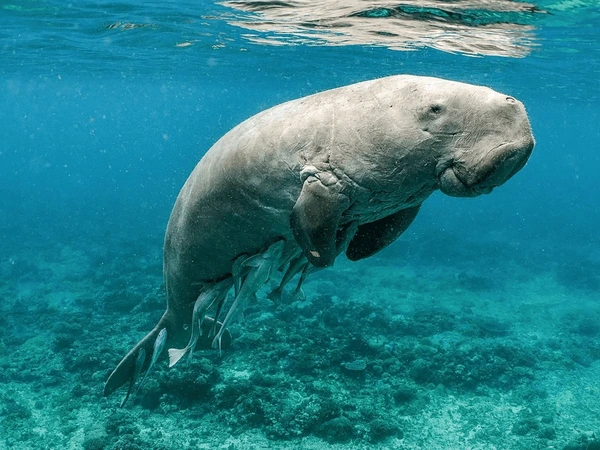
15 Mind-Blowing Dugong Facts Every Ocean Lover Should Know
1. The Dugong Inspired the Mermaid Legend
Sailors spent months at sea. A glimpse of a dugong nursing its calf at the surface looked, from a distance, like a woman holding a baby.
Many researchers believe this is where mermaid myths began. The word “dugong” itself comes from the Malay duyung, which means “lady of the sea.”
2. It Is the Only Strictly Marine Herbivorous Mammal
Whales, dolphins, seals and sea lions all hunt animals. The dugong grazes on plants.
It is the only mammal that lives entirely in the sea and eats a plant-based diet. Its cousin, the manatee, also enters rivers and freshwater.
3. Its Closest Living Relative Is the Elephant
Dugongs look nothing like elephants, yet genetics places them on the same branch of the mammal family tree. Both belong to a group called Afrotheria.
The dugong’s tusks, dense bones and long lifespan all echo its distant, land-walking cousin.
4. It Eats About 30 to 40 Kilograms of Seagrass a Day
A dugong spends most of its waking hours eating. An adult can munch through roughly 30 to 40 kilograms of seagrass daily.
That is the weight of a large sack of rice, eaten every single day, one mouthful at a time.
5. Dugongs Leave Visible “Feeding Trails” on the Seabed
A dugong uses its bristled, downturned snout like a vacuum cleaner. It ploughs along the sand and uproots seagrass, leaving winding furrows behind.
Scientists can spot these trails from boats and aircraft. They use them to track where dugongs are feeding.
6. Male Dugongs Grow Tusks for Fighting
Males develop tusks as they reach maturity. They use them in scuffles with rivals during the breeding season.
Tusks also grow in layers, a bit like tree rings. Researchers read those layers to estimate an animal’s age.
7. The Tail Looks Like a Whale’s
The dugong’s tail is a crescent-shaped fluke, similar to a dolphin’s or whale’s. A manatee’s tail, by contrast, is a rounded paddle.
This is the easiest way to tell the two cousins apart in photographs.
8. Dugongs Are Among the Slowest Breeders in the Sea
A female may not have her first calf until she is anywhere from 6 to 17 years old. Pregnancy lasts about 13 to 14 months.
She usually gives birth to a single calf, then often waits several years before breeding again. That slow pace is a major reason these animals struggle to recover from population losses.
9. They Can Live for Up to 70 Years
A dugong born today could still be grazing on seagrass in the 2090s. Long lives are typical of slow-growing, slow-breeding animals.
Sadly, few reach old age today because of fishing nets, boat strikes and habitat loss.
10. Whiskers Do the Seeing
Dugong eyesight is limited, especially in cloudy coastal water. Sensitive bristles on the snout and stiff hairs across the body pick up touch and movement instead.
Combined with good hearing, this lets a dugong “read” its surroundings and find food in murky shallows.
11. Their Bones Are Heavy on Purpose
Dugong ribs and other bones are unusually dense and heavy. This works as natural ballast and helps the animal stay down while it grazes on the bottom.
Most mammals have lighter bones. The dugong’s skeleton is built for staying under, not floating up.
12. Their Cousin, Steller’s Sea Cow, Vanished in 27 Years
Steller’s sea cow was a giant relative that grew far larger than any dugong. Europeans described it in 1741. By around 1768, hunters had wiped it out.
It is one of history’s fastest human-driven extinctions. It is a reminder of how fragile slow-breeding sea animals can be.
13. Dugongs Live in About 40 Countries
Their range stretches across the warm coastal waters of the Indo-Pacific, from East Africa to Australia and the Pacific islands. Northern Australia is a global stronghold with the largest populations.
The dugong is listed as Vulnerable by the IUCN Red List, and many local populations are in steep decline.
14. India Has Only a Few Dugongs Left
In Indian waters, dugongs survive in the Gulf of Mannar, Palk Bay, the Gulf of Kutch and the Andaman and Nicobar Islands. They are protected under Schedule I of the Wildlife Protection Act, 1972.
In 2022, Tamil Nadu announced India’s first dugong conservation reserve in Palk Bay, covering nearly 450 square kilometres.
15. Protecting Dugongs Protects the Climate
Seagrass meadows are among the planet’s most efficient carbon stores. Dugongs help keep them healthy by grazing and turning over the seabed.
When seagrass disappears, dugongs go hungry and stored carbon can escape back into the atmosphere. Healthy meadows mean healthy coasts, healthy fisheries and a cooler planet.
From Ocean Wonders to Scuba Diving in Kovalam
That wraps up our tour of the sea cow’s world. Now let’s turn to something you can actually book this week.
If you have ever wondered what lies beneath Kerala’s waves, scuba diving in Kovalam is the answer. It is a real adventure, it is beginner-friendly and it is closer than you think.
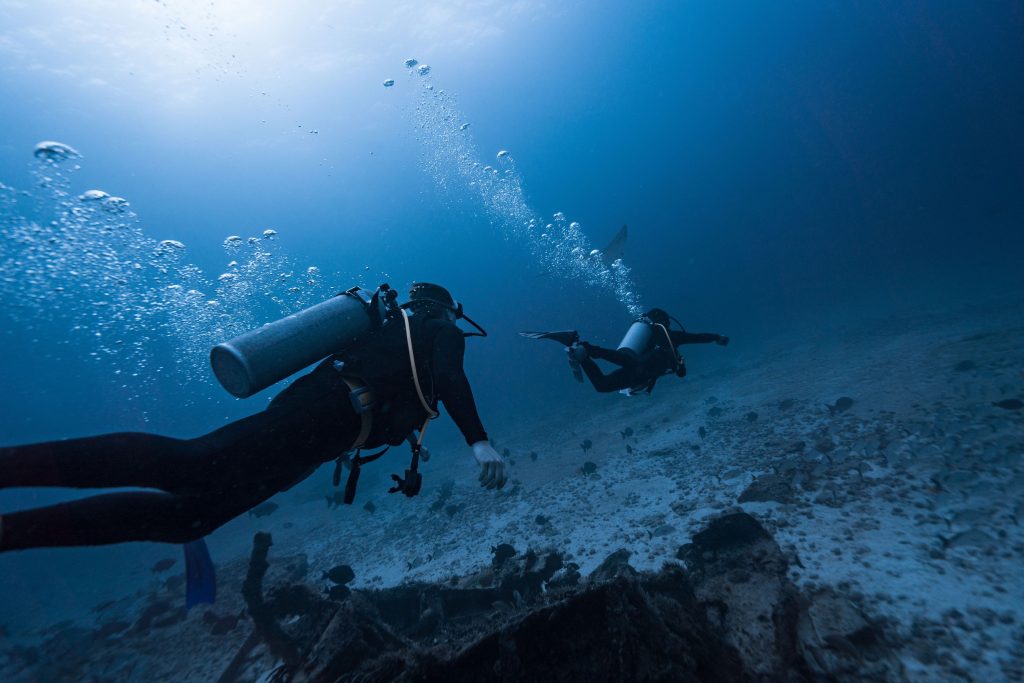
Why Scuba Diving in Kovalam Belongs on Your Bucket List
Kovalam is famous for its crescent beaches, swaying palms and lighthouse views. But the real show happens below the surface.
Scuba diving in Kovalam takes you into the Arabian Sea. You trade traffic, phone notifications and daily stress for calm, weightless quiet.
Here is why so many travellers rank it a must-do:
- It is easy to reach. Kovalam is a short drive from Thiruvananthapuram airport and railway station.
- It suits first-timers. Guided introductory dives need no previous experience.
- It is warm. Arabian Sea water stays pleasantly warm through most of the year.
- It is unforgettable. Few things match your first breath underwater.
Whether you are a solo traveller, a couple on honeymoon, a group of college friends or a family on holiday, scuba diving in Kovalam fits your trip.
Meet Bond Safari: Your Base for Scuba Diving in Kovalam
Bond Safari is a water sports and scuba diving centre based in Kovalam, Kerala. The team focuses on safe, guided and enjoyable experiences for beginners and certified divers alike.
Every booking for scuba diving in Kovalam with Bond Safari includes:
- Trained, professional instructors
- A complete safety briefing before you enter the water
- Quality diving equipment
- One-on-one guidance during your dive
- Photo and video options to relive the moment (ask the team when you book)
You never have to figure anything out alone. Instructors stay right beside you, guiding your breathing, your buoyancy and your movement.
Want to see the full range of options? Explore our scuba diving in Kovalam packages and pick the experience that matches your comfort level.
Beginner Scuba Diving in Kovalam: The Discover Scuba Diving Experience
The most popular way to start is an introductory dive, often called Discover Scuba Diving. It is designed for people who have never worn a tank before.
Under standard PADI guidelines, introductory dives stay in shallow water, typically no deeper than 12 metres (40 feet). That keeps everything relaxed, safe and beautiful.
Here is how a beginner session for scuba diving in Kovalam usually works:
- Arrive and register. You complete a short medical questionnaire and a briefing.
- Learn the basics. Your instructor explains breathing, equalising, hand signals and safety.
- Gear up. You are fitted with mask, fins, regulator, BCD and tank.
- Practise in shallow water. You clear your mask and get used to breathing underwater.
- Go deeper with your instructor. Then it is time to explore.
Worried about being nervous? That is completely normal. Most first-timers feel a little anxious, and nearly all of them come up smiling.
Ready to feel it yourself? Contact the team and book your introductory dive today.
What You Can See While Scuba Diving in Kovalam
Every dive is different. Marine life depends on the season, the site and the conditions on the day. That is part of the excitement.
Divers exploring Kerala’s coastal waters commonly look out for:
- Reef and rock fish: shoals of small, colourful fish darting around submerged structures
- Coral and marine growth: textures and shapes that make great photo subjects
- Crabs, shells and seabed creatures: the small details that keep experienced divers curious
- Larger visitors: sometimes turtles, rays or bigger fish pass through, though sightings are never guaranteed
Marine life is wild, so it will not perform on schedule. What you can count on is the feeling: sunlight streaming through the water, your own bubbles rising and a peace that is very hard to describe on land.
For many people, scuba diving in Kovalam becomes the highlight of their entire Kerala trip.
Your Dive Day, Step by Step
Here is what a typical day of scuba diving in Kovalam with Bond Safari looks like.
Morning check-in. You meet the team, sign in and confirm your booking details.
Briefing. Your instructor walks you through the plan, the signals and the safety rules.
Kitting up. The crew fits your equipment carefully. Comfort matters, so speak up if anything feels tight.
Into the water. You take your first controlled breaths and get used to the sensation.
Your dive. You explore with your instructor at a relaxed pace.
Surfacing and celebrating. You come up, take off the gear and share stories. Most people are already planning their next dive.
The whole experience fits easily into a morning or afternoon. You can still enjoy the rest of your Kovalam day.
Best Time for Scuba Diving in Kovalam
Timing shapes your experience, so plan ahead.
- October to May: This is generally the best season for scuba diving in Kovalam. The sea is typically calmer, the weather is pleasant and visibility is usually better.
- June to September (monsoon): Rough seas and heavy rain often limit water activities. Diving may be restricted for safety.
Sea conditions change from day to day, so Bond Safari confirms your slot based on the weather. If you are planning a trip, book early. Peak months like December and January, plus holiday weekends, fill up fast.
Not sure which date works? Ask the team about availability for scuba diving in Kovalam before you lock in your travel plans.
Level Up: PADI Courses for Scuba Diving in Kovalam
A single dive can quickly turn into a passion. If you fall in love with the sport, you can train toward internationally recognised certification with PADI, the world’s largest scuba training organisation.
The usual path looks like this:
- PADI Open Water Diver: The first full certification. Once you hold it, you can dive with a buddy up to 18 metres at dive sites around the world.
- PADI Advanced Open Water Diver: Builds skills such as deeper diving and navigation.
- Rescue and specialty courses: Add confidence, safety knowledge and new interests.
- PADI Divemaster and beyond: Turn diving into a career. Bond Safari has celebrated students who went from beginners to professional instructors working abroad.
Certification means your scuba diving in Kovalam can become the start of a lifetime hobby, or a new job in the world’s best dive destinations. Thinking about it? Check out our PADI courses in Kovalam to see what suits you.
Is Scuba Diving in Kovalam Safe?
Safety comes first, always. Dive professionals follow strict procedures for a reason.
Here is what keeps scuba diving in Kovalam safe:
- Trained instructors supervise every session
- Equipment is checked before each dive
- Beginners stay in shallow, controlled conditions
- Dives are called off when weather or sea conditions are poor
- You receive a full briefing on breathing and hand signals
You must also do your part. Be honest on your medical form, listen closely to your instructor and never hold your breath underwater. Breathe continuously and calmly at all times.
A few conditions, such as certain heart, lung or ear problems, can make diving unsafe. If you have any health concern, check with your doctor before booking.
Who Can Try Scuba Diving in Kovalam?
Most healthy people can try it. General guidelines include:
- Age: Introductory programmes typically start at 10 years old, with parental consent for minors.
- Swimming: You do not need to be a strong swimmer for an introductory dive, but you should feel comfortable in water. Tell your instructor if you are nervous.
- Health: You need to be in reasonable health and complete a medical questionnaire.
- Fitness: No athletic training is required.
Please confirm the current requirements with the Bond Safari team when you book, since policies can change.
What to Bring for Scuba Diving in Kovalam
Pack light. The centre provides the technical diving equipment. You only need a few personal items:
- Swimwear
- A towel
- Sunscreen (reef-friendly if possible)
- A change of clothes
- Sunglasses and a hat for the boat ride or beach
- Water and a light snack
- Motion-sickness tablets if you tend to feel unwell on boats
Pro tip: Avoid heavy meals right before your dive, and skip alcohol the night before. You will enjoy the water far more feeling fresh.
Make It a Full Adventure Day in Kovalam
Scuba diving in Kovalam pairs well with other things to do on this stretch of coast. After your dive, you can:
- Relax on Lighthouse Beach or Hawa Beach
- Ask Bond Safari about other water sports such as parasailing
- Wander through the local cafés and seafood restaurants
- Watch the sunset from the lighthouse area
- Explore nearby Thiruvananthapuram for temples, museums and shopping
A day of scuba diving in Kovalam followed by a beach sunset is one of the most memorable itineraries in southern Kerala.
Tips for Your First Scuba Diving in Kovalam Experience
Follow these simple tips to get the most from your dive:
- Breathe slowly and steadily. It is the most important rule in diving.
- Equalise early and often. Pinch your nose gently and blow to relieve pressure in your ears.
- Stay relaxed. Tension burns air and makes everything harder.
- Trust your instructor. They do this every day.
- Never touch or chase marine life. Look, enjoy and leave everything as you found it.
- Ask questions. No question is too silly.
Respect for the ocean is part of the sport. Divers are visitors in a delicate ecosystem, so we protect it with every fin kick.
Frequently Asked Questions About Scuba Diving in Kovalam
Do I need experience for scuba diving in Kovalam?
No. Introductory dives are built for complete beginners, and your instructor guides you throughout.
How long does scuba diving in Kovalam take?
The full session, including briefing, gearing up and your dive, typically takes a few hours. Actual time underwater varies with the programme.
Can non-swimmers try scuba diving in Kovalam?
Many non-swimmers enjoy introductory dives, provided they are comfortable in water and honest with the instructor. Ask the Bond Safari team about your specific situation.
What is the best month for scuba diving in Kovalam?
The calmer season from October to May is generally best, with December to March especially popular.
Can I get certified while scuba diving in Kovalam?
Yes. Bond Safari offers PADI training, so you can move from your first dive toward Open Water certification and beyond.
How do I book scuba diving in Kovalam?
Contact Bond Safari by phone, WhatsApp or through the website. Choose your date, confirm your slot and show up ready for adventure.
Book Scuba Diving in Kovalam with Bond Safari Today
Every diver remembers the moment their head goes under the surface and the noise of the world fades away. It feels like a secret opened just for you.
That moment is waiting in Kovalam. With experienced instructors, quality gear and a safety-first approach, Bond Safari makes scuba diving in Kovalam simple, thrilling and unforgettable.
Do not just read about the underwater world. Go and see it.
👉 Book your scuba diving in Kovalam experience now and send us an enquiry today. Slots fill fast in peak season!